
SEO in 2026 is no longer the same system that dominated digital marketing for the past decade. The traditional idea of “ranking on Google with keywords and backlinks” has evolved into a far more complex ecosystem driven by AI, user intent, and authority signals. Search is no longer limited to Google alone—AI-powered search engines, chat-based assistants, and answer engines like Gemini-style systems are now reshaping how users discover information.
This shift has created confusion among website owners and marketers. Many believe SEO is dead because organic traffic patterns have changed dramatically. In reality, SEO has not disappeared—it has transformed into something more intelligent and user-focused.
In 2026, success in SEO depends less on technical tricks and more on understanding what users actually want, how AI systems interpret content, and how trust is built across the web. Google and other search systems now prioritize meaning over keywords, depth over surface-level content, and credibility over volume.
In this guide, we will break down exactly how SEO works in 2026 step by step. You will learn how search engines interpret content, how ranking signals have changed, and what strategies actually work today. Whether you run a blog, a job portal like Remlance, or a business website, understanding this system is essential for staying visible online.
By the end, you will clearly understand why SEO is still powerful—but only for those who adapt to the new rules of search.
What SEO Means in 2026 (Not What It Used to Be)
SEO in 2026 is best understood as “Search Experience Optimization” rather than traditional “Search Engine Optimization.” The goal is no longer just to rank a page on Google, but to ensure that users—and increasingly AI systems—find your content as the most relevant and trustworthy answer to a query.
Search engines have evolved into hybrid systems combining traditional ranking algorithms with large language models. This means Google, Bing, and AI-powered assistants now evaluate content more like a human reader than a keyword-matching machine.
Instead of relying heavily on exact-match keywords, modern SEO systems interpret meaning, context, and relationships between entities. For example, if a user searches for “best remote jobs in 2026,” the system does not just look for pages repeating those words. It analyzes job categories, salary expectations, user intent, and authoritative sources in the remote work niche.
Another major change is the shift toward “zero-click search.” Many users now receive answers directly in AI summaries or search snippets without visiting websites. This means visibility is no longer just about clicks—it is about being included in the answer layer itself.
In this environment, SEO success depends on three core elements: intent alignment, content depth, and trust signals. Websites that fail to demonstrate expertise or structure their content clearly are increasingly ignored by AI-driven ranking systems.
In short, SEO in 2026 is no longer about gaming algorithms. It is about becoming a reliable knowledge source that AI systems confidently reference when generating answers.
Step 1 — Understanding Search Intent (The Foundation of SEO)
Search intent has become the most important ranking factor in 2026. While keywords still exist, they are no longer the driving force behind rankings. Instead, search engines focus on understanding why a user is searching for something.
There are three primary types of search intent: informational, transactional, and navigational. However, in 2026, these categories are more fluid and context-dependent. AI systems analyze not just the query, but also the likely goal behind it.
For example, a search like “best remote jobs” could mean different things depending on the user. One person may be looking for high-paying roles, another for entry-level opportunities, and another for freelance gigs. Modern SEO requires content that satisfies multiple layers of intent within a single topic.
This is why pages that only target keywords without addressing user needs fail to rank. Search engines now evaluate whether a page fully resolves the user’s problem. If it does not, AI systems prefer alternative sources.
Intent mapping is now a core part of content strategy. Successful websites build content that directly aligns with user expectations at every stage of the journey—from awareness to decision-making.
For example, a job portal like Remlance must not only publish job listings but also guides like “how to get remote jobs,” salary breakdowns, and skill requirements. This creates a complete intent ecosystem that search engines recognize as valuable.
In 2026 SEO, understanding intent is no longer optional—it is the foundation of visibility.
Step 2 — Topical Authority Over Single Keywords
Topical authority has replaced keyword targeting as a primary ranking strategy. Search engines now prioritize websites that demonstrate deep expertise across an entire subject area rather than isolated pages targeting individual keywords.
In simple terms, Google no longer trusts a single article—it trusts a network of knowledge. If your website consistently publishes high-quality content around a specific topic, it builds authority in that niche.
For example, a site that only publishes one article about “remote jobs” will struggle to compete. However, a site that publishes multiple interconnected articles—covering job listings, skill guides, salary trends, application tips, and industry insights—will be seen as a trusted authority.
This is where content clusters become essential. A cluster is a group of related articles internally linked together around a central topic. These links help search engines understand the relationship between pages and identify the website’s expertise.
Internal linking plays a critical role in reinforcing this structure. It guides both users and AI systems through a logical content journey, improving engagement and comprehension.
Topical authority is especially important in competitive industries like jobs, finance, health, and technology. Websites that fail to build depth are often replaced by more comprehensive competitors—even if their individual articles are well-written.
In 2026 SEO, ranking is no longer about who writes one good article. It is about who owns the entire topic ecosystem.
Step 3 — How AI Search Engines Read Your Content
AI search engines in 2026 no longer “crawl and match keywords” in the traditional sense. Instead, they interpret content using large language models that understand context, entities, and relationships between ideas.
When AI systems analyze a page, they break it down into semantic components. These include topics, named entities, intent signals, and supporting evidence. The goal is to determine whether the content fully answers a user’s query in a reliable way.
For example, if an article discusses “remote jobs,” the AI will look for related concepts such as job categories, salary data, work requirements, and industry trends. If these elements are missing, the content may be considered incomplete.
Structured data also plays a major role in helping AI systems interpret content accurately. It provides machine-readable context that improves how information is categorized and surfaced in search results.
Unlike traditional SEO, AI search does not rely heavily on exact keyword placement. Instead, it evaluates how naturally concepts are connected throughout the content.
This means writing for AI requires clarity, depth, and logical structure. Content that is vague, repetitive, or poorly organized is less likely to be surfaced in AI-generated answers.
Another major change is the rise of “answer extraction.” AI systems often pull specific sections from web pages to generate direct responses. This means each section of your content must be independently valuable and clear.
In 2026, writing for AI search means writing for understanding—not just indexing.
Step 4 — Content Quality Signals That Actually Matter Now
Content quality in 2026 is defined by depth, clarity, and authenticity rather than keyword density or word count. Search engines and AI systems now evaluate whether content provides genuine value based on how well it solves user problems.
One of the most important factors is first-hand experience. Content that demonstrates real-world usage, insights, or expertise is prioritized over generic information. This aligns with Google’s E-E-A-T principles, which remain a core ranking framework.
Another key signal is completeness. High-ranking content must fully address the topic without leaving gaps. If a user needs to visit multiple pages to understand a subject, search engines interpret the content as insufficient.
Freshness is also critical. Outdated content is quickly deprioritized, especially in fast-changing industries like technology, finance, and remote work.
In addition, engagement signals matter more than ever. If users spend more time on a page, scroll deeply, or interact with multiple sections, it signals content usefulness.
Thin SEO content no longer performs well, even if it is optimized with keywords. The algorithm has become more capable of identifying superficial writing.
In 2026, quality content is not just well-written—it is useful, structured, and experience-driven.
Step 5 — Backlinks Still Matter (But Not Like Before)
Backlinks remain an important ranking factor in 2026, but their role has evolved significantly. They are no longer the primary driver of rankings but instead function as trust and credibility signals.
Search engines now focus heavily on the quality and relevance of backlinks rather than quantity. A single link from a highly authoritative, contextually relevant site is far more valuable than dozens of low-quality links.
In addition to traditional backlinks, brand mentions without hyperlinks are also recognized as authority signals. This means that being discussed across the web contributes to your credibility even if no direct link is provided.
Context is equally important. A backlink from a relevant industry site carries more weight than a generic link from an unrelated domain.
Spammy link-building tactics that once worked are now largely ineffective and can even harm rankings. Search engines are much better at detecting unnatural link patterns.
In 2026 SEO, backlinks are no longer about manipulation—they are about validation. They confirm that your content is trusted by others in your field.
Step 6 — Technical SEO in 2026 (Still Critical)
Technical SEO continues to be a foundational requirement in 2026. While content quality and intent are crucial, technical performance ensures that search engines can properly access, understand, and index your website.
Core Web Vitals remain an important ranking factor, with page speed, interactivity, and visual stability directly influencing visibility. Mobile-first indexing is now fully standard, meaning websites that do not perform well on mobile devices are heavily penalized.
Crawlability and site architecture are also critical. Search engines must be able to efficiently navigate your site structure without encountering barriers such as broken links, duplicate pages, or unnecessary redirects.
Structured data has become increasingly important in helping AI systems understand page content. It improves how information is categorized and displayed in search results, especially in AI-generated summaries.
Security and HTTPS remain baseline requirements, and websites without them are considered unreliable.
In 2026, technical SEO is less about advanced tricks and more about ensuring your site is clean, fast, and easily understandable by machines.
Step 7 — E-E-A-T Is the Ranking Backbone
E-E-A-T—Experience, Expertise, Authoritativeness, and Trust—has become one of the most important frameworks in SEO. In 2026, it acts as the foundation for determining whether content is credible enough to rank.
Search engines now evaluate not only what is written but who is writing it. Author identity, professional background, and real-world experience all contribute to trust signals.
Websites that demonstrate clear expertise in a niche are more likely to rank than anonymous or generic content sources. This is especially important in competitive industries like health, finance, and careers.
Authoritativeness is built through consistent publishing, strong internal linking, and external validation from other reputable sources.
Trust is reinforced through transparency, accurate information, and a strong brand presence across the web.
In 2026, SEO E-E-A-T is no longer a guideline it is a core ranking requirement.
Step 8 — Why Some Websites Lose Traffic in 2026
Many websites have experienced traffic drops in 2026 due to major shifts in search behavior and algorithm updates. One of the biggest reasons is the rise of AI-generated answers, which reduce the need for users to click on websites.
Another common issue is reliance on outdated SEO strategies such as keyword stuffing or shallow content creation. These approaches no longer meet modern quality standards.
Websites that fail to build topical authority also struggle, as search engines now prefer comprehensive sources over isolated pages.
In addition, lack of content freshness can lead to rapid ranking declines, especially in competitive industries.
Ultimately, websites lose traffic not because SEO is dead, but because they fail to adapt to how SEO has evolved.
Step 9 — How Websites Actually Grow Traffic Now
Modern traffic growth in 2026 depends on a multi-layered strategy rather than isolated SEO tactics. Successful websites focus on building content ecosystems that cover entire topics in depth.
Content clusters remain one of the most effective strategies. By interlinking related articles, websites create strong topical authority signals.
Programmatic SEO can also be effective when used carefully, allowing websites to scale content creation for long-tail queries.
However, organic growth now depends heavily on brand presence beyond Google. Social media, direct traffic, and AI search engines all contribute to visibility.
Consistency in publishing high-quality content is more important than chasing viral posts or quick wins.
In 2026, sustainable traffic growth comes from becoming a trusted source, not just a ranked page.
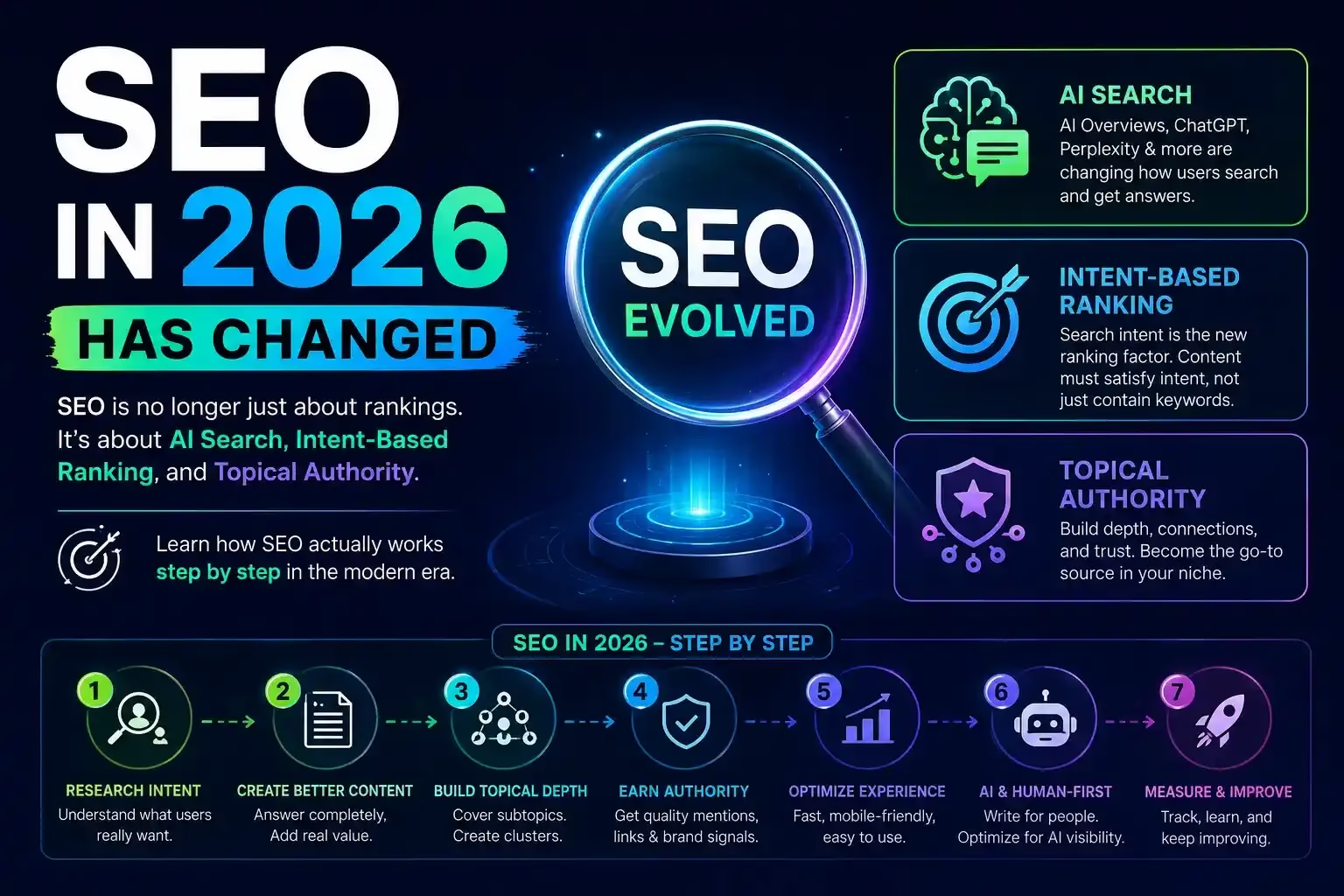
Step 10 — Step-by-Step SEO System in 2026 (Practical Workflow)
A modern SEO workflow in 2026 follows a structured, strategic approach. It begins with selecting a focused niche or topic universe, ensuring content relevance and depth.
Next, websites build content clusters around core themes, establishing topical authority. Each piece of content must align with user intent and provide meaningful value.
Internal linking is then used to connect related content and guide both users and search engines through the site.
Optimization for AI systems is essential, including structured data and clear semantic writing.
Authority is built through backlinks, brand mentions, and consistent publishing.
Technical SEO ensures the site is fast, mobile-friendly, and easy to crawl.
Finally, content must be updated regularly to maintain freshness and relevance.
This system reflects how SEO actually works in 2026—structured, intent-driven, and deeply integrated with AI understanding.
Conclusion
SEO in 2026 is not dead—it is simply more advanced, more intelligent, and more focused on user experience than ever before. The shift from keywords to intent, from pages to topics, and from links to trust has completely transformed how websites rank.
Success today depends on understanding how AI systems interpret content and how users interact with information. Websites that adapt to this new reality will continue to grow, while those that rely on outdated tactics will decline.
For platforms like Remlance, this evolution is an opportunity. By building strong topical authority in remote jobs, career guides, and digital work trends, you can position the site as a trusted source in a rapidly growing industry.
SEO is not disappearing—it is becoming smarter.